Bio
Sam Grigorian. Born Yerevan, 1957. Berlin since 1992.
Sam Grigorian was born in Armenia. At fourteen, painting was not a passion but an inner compulsion, an early and complete recognition that what he wanted to say could only be said through colour and surface. His work became increasingly expressionist in the years that followed, more extreme in its execution, more demanding in its relationship to material.
He began exhibiting in Armenia in the late 1970s and 1980s, and received recognition at the State Gallery and the Museum of Modern Art in Yerevan. The political conditions of the late Soviet era drew him westward. In 1992 he moved to Berlin, where the studio has remained ever since.
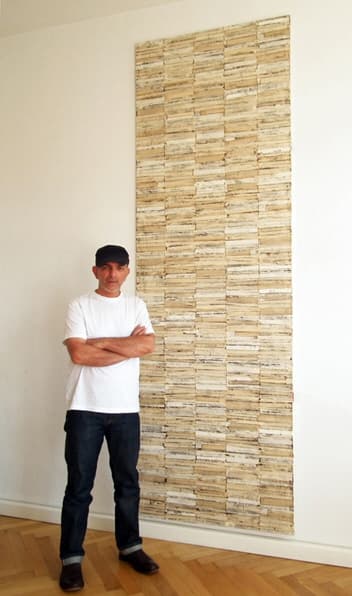
The international positioning of his work emerged early. In 1995 he participated in Art Cologne at Galerie Nothelfer, alongside Cy Twombly, Richard Serra and Robert Rauschenberg. In 2002 his work was shown at Galerie De Rijk in The Hague alongside Antoni Tàpies, Karel Appel and Pierre Alechinsky. These placements were not coincidental. They staked a claim about where the work belongs.
It was during this period that Sam began to understand what paper could become. He recognised that old paper carries time within itself. Decades of use, inscription, neglect, held in its layers. Through décollage, scraping, lifting, tearing, exposing, he learned to bring that time back to the surface, and in doing so give it new life. Sheet music found its way into the work in particular: worn scores that hold not only notation but a history of touch, of repetition, of sound. The material was no longer a support. It was the subject.
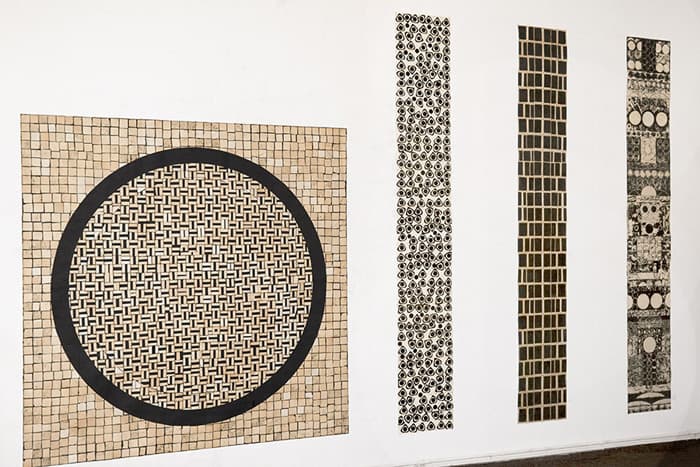
At the centre of his practice lies an unlikely but deeply felt connection. The structural freedom of jazz, the way Miles Davis, Thelonious Monk and John Coltrane made something vast from improvisation and restraint, runs through Sam's work as both method and disposition. Alongside this stand the illuminated manuscripts of early Armenian Christianity, with their compressed geometry, their gold, their sense that every mark carries devotional weight. And modern art as the space where these two sources could finally meet. The result is a body of work that belongs to no single tradition and draws quietly from all three.
Regular solo and group exhibitions across Europe, the United States, Australia, Singapore and Armenia deepened a practice that moves between painting, works on paper and large-scale surface constructions. Works are held in collections across all of these regions.
The ongoing series Happiness, begun in 2016 and worked predominantly in mixed media on canvas, takes its title from what remains, not from what is added. City, Behind the Fence and Visit from Another Planet follow the same logic: a surface that only reveals what it holds through removal.
Works are held in the New Orleans Museum of Art, the Museum of Modern Art Armenia, the Stiftung Reinbeckhallen Collection, and further private and institutional collections worldwide.